Lindemans, the most Art Nouveau of Belgian brewers
Some beers are meant to be drunk. Others are meant to be told. At De Ultieme Hallucinatie, we love a good story, and we’ve been wanting to tell you Lindemans’ story for a long time. A family-run brewery born in the fields of the Pajottenland, two centuries of expertise and a spirit surprisingly close to our own.
So, to uncover its secrets, we went to meet their account manager, Nico De Bell.

A beer born of the earth
It all began in 1822 in Vlezenbeek, in the heart of the Pajottenland. At the time, Joos Frans Lindemans and his wife Francisca were farmers. As the daughter of a brewer, she didn’t wait long to put her expertise to good use. Come evening, they would brew beer to quench the thirst of their farmhands. What began as a gesture of generosity soon became a passion, then a calling. Two centuries later, six generations have carried on this legacy. “If I had to sum up Lindemans in two words? Family-run and authentic,” Nico tells us during our meeting. The small farm-brewery is now the world’s largest family-run lambic brewery, exporting to over 50 countries, without ever losing sight of its roots.
A gift from nature
What makes Lindemans unique is lambic. And lambic is the art of letting nature do its work. The brewery uses spontaneous fermentation to create its beers, and the principle is fascinating. The wort (a mixture of water, malted barley, wheat and aged hops) is left exposed to the open air in a large open vat. The wild yeasts of the Senne Valley do the rest. The brewers therefore add no yeast at all! This traditional method has remained unchanged over the centuries. Then comes the time for patience… Six to seven months of slow fermentation and several years of maturation in huge oak barrels.
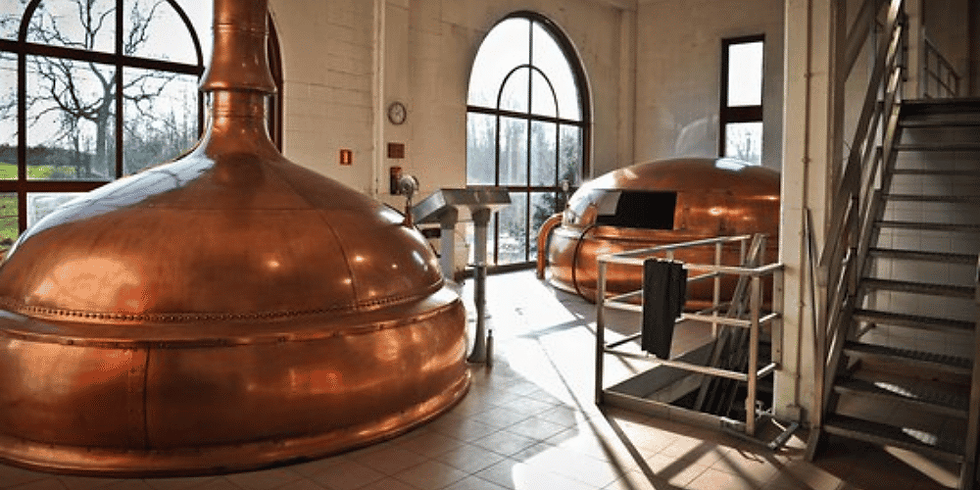
🍺 Did you know? During the Second World War, the Lindemans family did everything they could to protect their precious copper vats. To prevent them from being seized by the occupying forces, they came up with the incredible idea of hiding the iconic vat... at the bottom of a nearby pond! It was only once peace had returned that it was retrieved and restored to working order. |
The ‘Champagne of Pajottenland’ on your table
Once bottled, the lambic undergoes a second fermentation and transforms into gueuze. The name actually comes from the French word for ‘sparkling’ (gazeux), and it is during this second fermentation that the natural sugars produce the bubbles. But just like a fine wine, each batch is unique, influenced by temperature, humidity and the whims of nature. To ensure consistent quality despite these variations, the master brewers blend several batches together to achieve, over time, that perfect balance between acidity and freshness that defines it.
“You can compare lambic to champagne. It’s the same production method. The beer undergoes a second fermentation in our oak barrels, then again in the bottle. We call it the champagne of the Pajottenland.” – Nico De Bell
The journey that made the corks pop
In fact, in the 19th century, lambic brewers would travel to Brussels to collect empty champagne bottles because they were the only ones sturdy enough to withstand the pressure of lambic’s secondary fermentation.
And speaking of pressure… Nico shared a delightful anecdote with us about Kriek.
In the late 1970s, Charles Finkel, an American importer, persuaded the Lindemans family to export their beers to the United States. What nobody had anticipated was that the swell of the waves at sea would reactivate fermentation in the bottles, putting the corks under such pressure that they popped during the journey.
René and Nestor Lindemans could have given up… But they innovated! To stabilise the beer and make it suitable for international transport, they developed a new method. Freshly pressed sour cherry juice, macerated with a lambic aged for at least a year, then pasteurised to halt fermentation after bottling.
Kriek can now be shipped to the four corners of the globe, but for those who want the original recipe, the traditional method lives on in Lindemans Oude Kriek Cuvée René.

Lindemans has never become stuck in the past. While remaining true to its fermentation method, it continues to shake up the status quo. Recently, the brewery has surprised us with unexpected creations such as lambics infused with basil or ginger, and even non-alcoholic versions. As Nico sums it up: “We remain true to our roots, but we continue to surprise.”
Art Nouveau in every bottle
Take a close look at our two logos. Does anything stand out to you?

The intertwining curves, the typography that looks straight out of a Belle Époque poster… It’s no coincidence. Lindemans is undoubtedly the most Art Nouveau of Belgian brewers, and that really speaks to us! Just as that movement sought to bring beauty into everyday life, this legendary brewery has made lambic a beer for everyone. Two worlds that seemed worlds apart, until you look a little closer. “De Ultieme Hallucinatie exudes Art Nouveau, just as we express it on our bottles. It’s a perfect match,” enthuses our interviewee. It just goes to show that, between our walls and their bottles, Art Nouveau isn’t just something to be admired… it’s something to be savoured.
A sip of sunshine
For Nico De Bell, the return of the sun goes hand in hand with the fruity range: “I think it’s really lovely in summer; it’s a real all-rounder.” Light, sparkling and appealing to all palates, there’s bound to be a Lindemans to suit your time on the terrace.
For a more authentic experience, the Vieille Gueuze remains the go-to choice. A beer with character, close to the original lambic, which tells the brewery’s story with every sip.
On the food front, we’ve been told that Kriek takes our meatballs in tomato sauce to the next level, whilst Faro is the perfect partner for our beef stews, bringing back all the flavour of old-school Brussels.
Now you know the story. The next step is the tasting.
Discover the full range on the menu at De Ultieme Hallucinatie!
All the mysteries of De Ultieme Hallucinatie
directly in your inbox.
